

- Working Mothers
- 10 mins
I know you've been dying to know more about the Listen to Your Mother's team. So here you have it. To celebrate National Working Mother's Day in 2026, we wanted to provide you with a peek behind the curtain of who Listen to Your Mothers is.
How it all began
Listen to Your Mothers was born from the real-life experiences of moms navigating demanding careers while raising children. Despite our different backgrounds, our team has experienced firsthand the challenges of being both mothers and professionals, and wanted to do something about it. Between dinners, bedtimes, illnesses, new jobs, and family obligations, we set out to amplify what mothers need, show that this isn’t just a “women’s issue,” and provide a clear call to action for employers.
Our journey actually started in high school, where Miriam and Andrea met — never imagining that 20 years later they would reunite as moms on a mission. Katrina and Miriam met working at a local education nonprofit before either of them were mothers, with Katrina shaping workplace policy as the head of HR and operations, and Miriam providing direct service to students. After Miriam earned her MBA, she met Renée - again at work. They went on to form an informal partnership, supporting each other through pregnancies and leaves while also supporting the students of Boston to access high quality opportunities. These long-standing relationships and shared experiences shaped the way we collaborate and work together to this day, recognizing that we all bring something unique to our business partnership.
From the start, we’ve been intentional about wanting to center and amplify the stories of mothers. That’s why we launched with a survey and report, gathering insights directly from moms to inform our work. Today, all our strategies, including our MOMentum Calculator and services, are guided by those stories. By listening to mothers and focusing on employers as the unit of change, we turn lived experience into actionable solutions that help teams flourish and organizations thrive.
Who We Are
.jpg?width=774&height=580&name=2024-11-22_LTYM-033-0004430_websize%20(1).jpg)
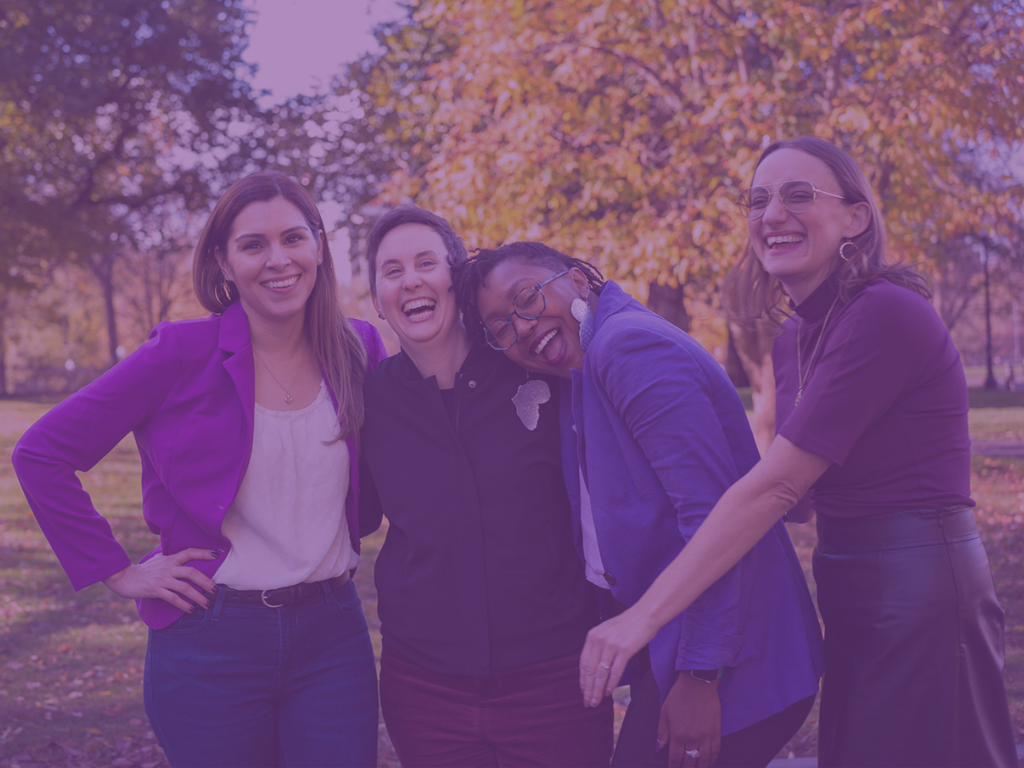
Shown from left to right: Andrea Lebron, Katrina Magdol, Renée Ọmọladé, and Miriam Rubin
Katrina Magdol
Katrina Magdol is the Chief of People & Operations, bringing extensive expertise in people and culture strategy, policy design, and organizational learning and development. Her leadership focuses on creating supportive, inclusive workplaces that foster growth and innovation. As a mother of two, Katrina cherishes the moments watching her daughters' relationship blossom, reflecting her deep appreciation for connection and growth both professionally and personally. Her work and life embody a commitment to nurturing relationships and empowering individuals to thrive.
Renée Ọmọladé
Renée Ọmọladé is the Chief of Strategy & Impact, with expertise in strategic implementation, leadership development, equity, and data-driven decision making. Renée is passionate about creating impact that center inclusivity and measurable outcomes. As a mother of three, she finds joy in rediscovering the magic of play and embracing the opportunity to be a kid again alongside her children. Renée’s commitment to fostering meaningful connections and innovative solutions reflects her dedication to both her professional mission and her family life.
Miriam Rubin
Miriam Rubin is the Chief Executive Officer, specializing in planning and implementation, budgeting, and change management. With a strategic mindset and a focus on operational excellence, she drives impactful initiatives that deliver sustainable growth. As a mother of two, Miriam treasures the experience of seeing the world anew through her children’s eyes, inspiring her to approach both life and leadership with fresh perspective and curiosity. Her ability to balance vision and execution reflects her dedication to creating meaningful change in all aspects of her work and family life.
Andrea Lebron
Andrea Lebron is the Chief of Marketing & Communications, with expertise in demand generation, marketing, branding, and communications. Andrea’s strategic vision and creative leadership have been instrumental in building strong brands and driving engagement. As a mother of three, she finds joy in watching her daughters navigate each stage of life, gaining inspiration from their growth and resilience. Andrea’s ability to balance innovation and connection underscores her dedication to creating impactful narratives, both in her professional work and personal life.
Why did you start Listen to Your Mothers?
Katrina: “For me, it wasn’t a single "aha" moment, but a series of realizations. It started when I became a mother and intensified while I was leading HR for a 150-person organization during the pandemic. Seeing other mothers forge nontraditional paths made it clear: employers can and should think more creatively, but they need the right support to do so."
Renée: "Parenthood shifted my entire perspective on work. I realized I couldn’t commit the same way I used to and I needed to adjust my own expectations to be successful. I began asking myself: How do I listen to myself as a mother? How do I advocate for what I need for both my family and my career? That reflection also made me think systemically about how workplaces could better support parents and create meaningful change.”
Miriam: “After I had my second kid, I felt that I had no choice but to leave my job. It was a painful decision for me because working and my professional ambition had always been core to my identity. I had a lot of guilt and felt isolated in my experience. After I put in my notice, working mothers - from my generation and generations before - came out of the woodwork to share similar experiences with me. I realized that there is power in us sharing our stories, and turning those stories into tangible actions that employers can take to be part of the solution.”
Andrea: “As a working mom of a young adult, teen, and pre-teen, I’ve learned parenthood challenges don’t disappear — they evolve. Childcare costs become summer camps and after-school activities. Worries about milestones turn into mental health and safety concerns. Time chasing toddlers becomes homework help and tough school-day talks. And leaving work early for a sick kid? Still real. Being a working parent isn’t one-size-fits-all. Some need paid leave or pumping rooms, others need flexibility for therapy or tutoring. Too many still sacrifice career growth. Workplaces must adapt to support parents at every stage.”
What policies from your workplaces benefitted you the most?
Miriam: "Generous leave was essential. I took four and a half months with both of my children, and because I’d been with my organization for a while, I was able to bridge my sick time and vacation to stay fully paid. Beyond leave, remote work was a game-changer. As a Budget Director during the pandemic, being remote meant I could manage a high-intensity role while still being present for my kids. I could step away for dinner or bedtime and jump back online later without losing time to a commute. It also made a world of difference during my second pregnancy; I was incredibly nauseous during my first trimester, and being able to work from home was a much more dignified experience than my first pregnancy, where I spent my days in the office plotting which bathroom I could duck into unnoticed."
Renée: "For me, it’s always been about 100% paid maternity leave. Having that financial security for each of my children allowed me to focus entirely on my family during those first few months. Now that I’m at an employer where that isn't the standard, it really makes you pause and consider what the future looks like. Comprehensive leave remains the most important foundation for any parent."
Katrina: "A few key supports stand out: paid parental leave, a gradual 'on-ramp' transition back to work, and practical office amenities like a nursing room with a hospital-grade pump. On a daily basis, having the flexibility to leave before 5:00 PM for daycare pickup and having a robust medical insurance plan were the benefits that truly sustained my family.
Andrea: "My experience was quite different because paid leave (PFML) wasn't available in Massachusetts when I had my kids. I had to fund my own short-term disability or burn through vacation time just to get a paycheck, which meant my leaves were short, my longest was only eight weeks. Looking back, the benefit that has been most transformative for my career and sanity is the ability to work from home. It completely changed my life and how I manage the needs of my family."
What does an "ideal" inclusive workplace look like for you, specifically in the context of supporting mothers?
Miriam: "It’s actually quite simple: an ideal workplace recognizes that people have full lives outside of the office. It values what individuals bring to the team and asks what they need to show up at their best. Instead of clinging to rigid policies that only work for a few, inclusive organizations show a willingness to learn and improve. True flexibility isn't a one-size-fits-all policy; it’s grounded in the unique, evolving needs of every employee."
Renée: "For me, it’s all about leading with trust. An ideal workplace trusts its employees to do the job they were hired for with minimal constraints. It means moving away from micromanagement and focusing on clear goals and priorities. When you provide the right conditions, like allowing people to work from where they are most effective, you foster higher engagement and empower people to meet high expectations."
Katrina: "The definition of 'ideal' is highly contextual. It depends on the industry, the business strategy, and the physical environment, whether it's a lab, an office, a factory, a school, etc. To build a truly inclusive space, you also have to look at the specific makeup of your workforce, and tailor your support to fit the reality of your daily operations. All too often, leaders dismiss an idea because they have never seen it work for their peers. We need to disrupt the norms to create true inclusion."
Andrea: "It all comes down to the tone set by leadership. I once worked with a C-suite leader who, as a father, consistently put family first. By setting that example, he created a culture where I felt both seen and safe as a mother. He proved that it is entirely possible to scale a fast-growing company while respecting personal boundaries. That legacy of 'leading by example' is the gold standard for workplace culture."
What keeps you motivated to move Listen to Your Mothers forward?
Miriam: "The sheer power of this team is my greatest motivator. Because we aren’t doing this in isolation, we’re able to lean on each other’s unique perspectives and strengths. When one of us is feeling frustrated or drained, someone else steps in to lift us up. I also find motivation in a shift in my own lens: I’ve learned not to exhaust my energy on those who are completely resistant to change. Instead, I’m fueled by the leaders who want to do better but simply don’t know how yet. Being the bridge for those who are ready for progress is incredibly rewarding."
Renée: "My motivation is rooted in a sense of necessity. To me, shifting the way we do business isn’t just an option; it’s an imperative. If we don’t get this right, we lose the talent we need for our workforce and our society to function efficiently. While systemic change can feel like a slow process, I’m driven by the momentum we build with the organizations that 'get it.' We focus on moving the needle with the willing, knowing that their success will eventually pull the rest of the business world along with them."
What kind of legacy do you hope Listen to Your Mothers will leave?
Miriam: "First and foremost, I hope our legacy is that mothers no longer feel isolated in the struggle to 'make it all work.' But beyond that, I want to see the investment shift where the challenges mothers face are no longer seen as 'women’s issues,' but as organizational priorities. I want to reach a point where it is culturally unacceptable for a company to lose talented mothers . We need to critically examine why that happens and fix it, because the workforce is stronger when mothers are in it. Ultimately, I hope Listen to Your Mothers helps workplaces recognize the inherent value that moms bring; not just when it’s convenient, but as a fundamental asset. It’s about moving toward a world where organizations finally start valuing people as people."
Renée: "It's important that we leave a legacy of courage. The courage to do the things that are not political or popular, but are necessary. I would love it if we were able to create workplaces where mothers feel successful and reciprocate by making their employers successful.
Andrea: "I want our legacy to be the proof that investing in mothers is the highest-yield investment a company can make. When an employer partners with us, they aren't just 'fixing' a HR problem; they are initiating a cycle of compound returns. Think about it: when you support a mother through a transition, you don’t just retain one employee. you preserve years of institutional knowledge, you build fierce brand loyalty, and you signal to every other employee that this is a place where humans thrive. That trust compounds. It lowers turnover costs, boosts recruitment through word-of-mouth, and creates a culture of psychological safety that drives innovation. I hope the legacy of Listen to Your Mothers is a shift in the corporate mindset: seeing that the 'cost' of support is nominal compared to the exponential, long-term dividends of a loyal, empowered, and multi-generational workforce."